
Pricing & Cost · Connecticut
What does a boat survey include for the price?
For $30 to $35 per foot, a pre-purchase survey checks every accessible system on the boat and ends in a signed report a lender will accept. Here is what that price buys, and what it does not.
The short version
- A pre-purchase survey includes a full inspection of five systems: hull and structure, mechanical and propulsion, electrical, rigging, and safety gear. At Helm that runs $30 to $35 per foot, with no deposit.
- The price includes a 30+ page written report with a photograph of every finding, a plain-language summary, and a fair-market valuation your lender and insurer will accept.
- The inspection takes four to six hours on-site, and the written report is delivered within two business days.
- The engine gets a visual and operational check. A full internal engine evaluation is a separate mechanical survey, which Helm can coordinate.
- A survey is non-destructive: it does not open structure, dismantle the engine, or remove fixed joinery, and it is not a warranty.
For $30 to $35 per foot, a pre-purchase boat survey includes a top-to-bottom inspection of every accessible system on the vessel, plus a written report and a fair-market valuation. That covers the hull and structure, the mechanical and propulsion package, the electrical system, the rigging where fitted, and the safety gear. The deliverable is a 30+ page Marine Survey Report that documents every finding with photographs. The rest of this guide breaks down exactly what the surveyor checks, what lands in the report, and the few things the standard price does not cover. For the headline numbers by boat length, see our guide to marine survey cost in Connecticut.
What does a pre-purchase boat survey include?
A pre-purchase survey includes an inspection of five core systems, each examined for condition, safety, and signs of past or developing trouble. At Helm, the accredited surveyor who inspects your boat covers:
- Hull and structure — moisture readings on the deck and hull, gelcoat and laminate condition, keel and rudder attachment, bulkheads, and evidence of prior damage or repair.
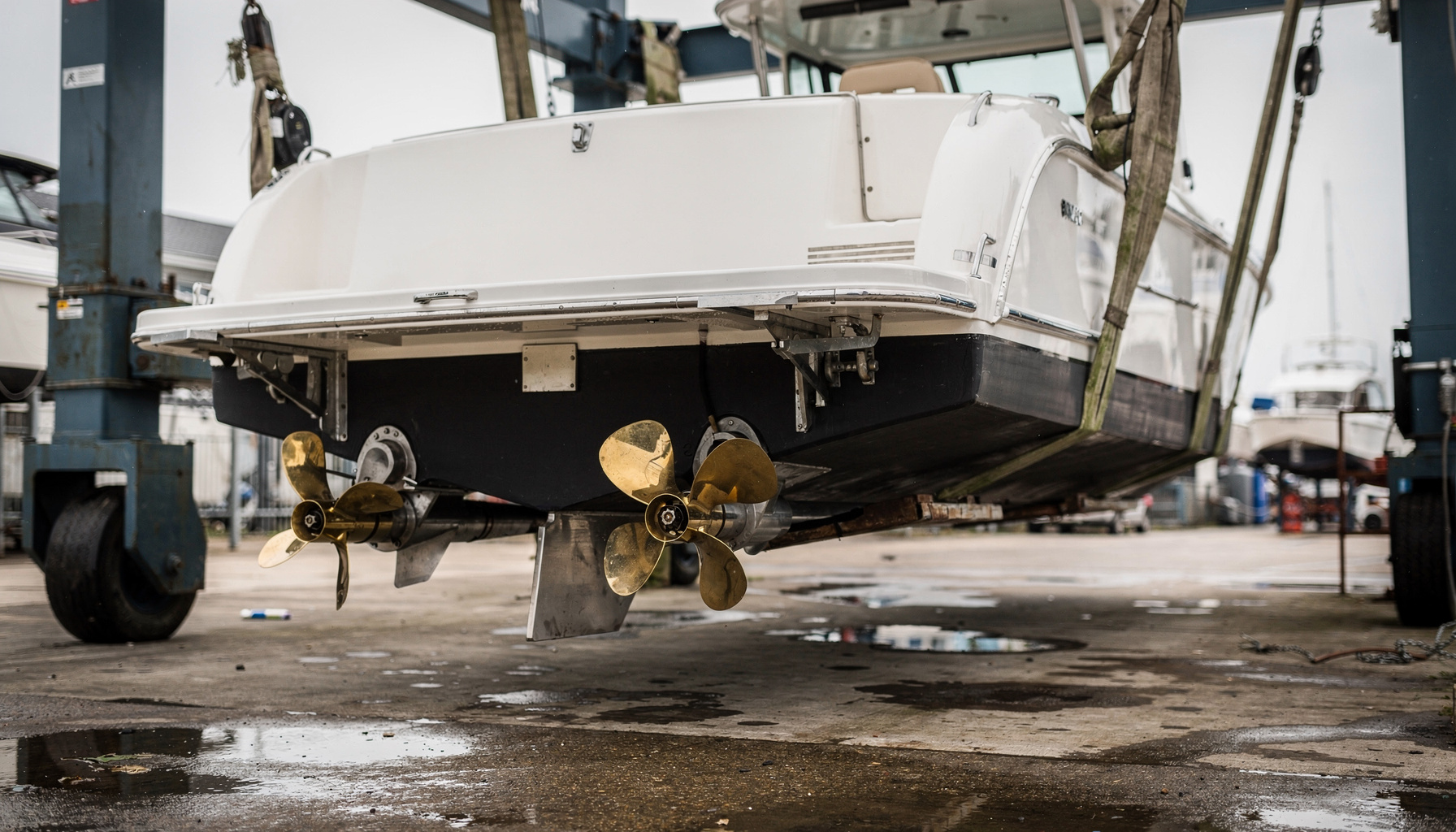
- Mechanical and propulsion — a visual and operational assessment of the engine, drivetrain, and steering, observed with the systems running.
- Electrical — wiring condition, panels, batteries, charging, and corrosion, checked against safe-practice standards.
- Rigging and sails (where fitted) — standing and running rigging, chainplates, fittings, and signs of fatigue.
- Safety gear and systems — bilge pumps, through-hulls, ground tackle, and fire and life-safety equipment.
That is the same scope on a 24-foot center console and a 44-foot sloop. What changes between boats is how long each system takes to inspect and document, not which systems are looked at. For a step-by-step account of how those checks happen on the dock, on the hard, and under way, see what happens during a marine survey.
What's in the written report?
The price includes a 30+ page written Marine Survey Report, and that report is the part you keep. It documents every finding with a photograph, sorts issues by how urgent they are, states the boat's overall condition, and assigns a fair-market valuation based on the vessel and comparable boats.
A good report identifies the boat by name, hull identification number, and registration, lists its published dimensions and construction, and groups findings by severity so you can tell a safety item from a cosmetic one. It is delivered within two business days of the inspection, and the accredited surveyor who inspected the boat is the one who writes and signs it. There is no junior handoff and no anonymous template, and you can reach that person with questions long after delivery. Helm's reports are accepted by marine lenders and insurers, and can be formatted to a specific lender's or carrier's requirements on request. Because that report routinely pays for itself, it is worth reading our take on whether a marine survey is worth it.
Is the engine included in the price?
Yes, with one important limit: the price includes a visual and operational assessment of the engine, drivetrain, and steering, but not an internal teardown. The surveyor starts and runs the engine, observes it under load where a sea trial is possible, and reports what the systems show in their working state.
A full internal engine evaluation — oil analysis, compression or borescope testing — is a separate mechanical survey performed by a marine mechanic, which Helm can coordinate when an engine is high-hour or high-value. The two surveys answer different questions: see how a mechanical engine survey differs from a pre-purchase survey.
Does the price include a sea trial or haul-out?
The standard per-foot price covers the boat in and out of the water as access allows, but a sea trial and a haul-out both depend on the seller and the yard. A sea trial, running the boat under way, and a short-haul or out-of-water inspection can be arranged when the seller or yard makes the boat available.
Any lift or yard fees for that come from the facility, not from Helm, and we tell you so up front. Helm travels to the vessel wherever it is slipped or hauled, across all of Connecticut and Long Island Sound, from Greenwich to Stonington, with no travel surcharge for the vast majority of locations.
What a boat survey does not include
A pre-purchase survey is non-destructive, so it does not open up structure, dismantle the engine, or remove fixed joinery to inspect what is behind it. It is a thorough inspection of what can be seen, reached, and operated on the day, and it is not a warranty or a guarantee of future performance.
Where the surveyor finds something that needs a specialist — a deeper engine look, a rig that should come down for closer inspection, a tank that should be pressure-tested — the report says so plainly. Being honest about those limits is part of the job, not a loophole. When you are ready, you can schedule a survey with no deposit and no card on file.